
I got my first Smartphone in 2013. Over the last 11 years, the slow, upward swipe of my thumb up my phone’s screen has become intimate: a physical movement and sensation that signals, that I’m about to witness the art of someone I’ve never met; watch videos of friends’ music; see snapshots of their babies’ expressions; rage together against the freshest hell du jour; or enjoy a moment of extreme peace of a friends’ most recent adventure. Everytime I open instagram or Facebook, I prepare myself to laugh, to cry, to breathe.
As I scroll, I stop. It is late October 2023, early in this current, intense wave of genocide of the Palestinian people. I greet a new poet, reading The View from My Window in Gaza as he, his family and community orient themselves, at a time we didn’t know would be the beginning of a much longer wave of violence. Forward, I would follow Mosab Abutoha’s work, as the genocide continues, longer and longer. The live conversation created over social media offers snapshots of poets’ finished work, as well as their interiority– reflections on craft, little influential moments, shy-brags, vents and catches, and quickly I turned to Mosab, and other Palestinian creators, to make sense of– and help direct– the deep process of this chapter.
I wasn’t sure I was prepared to act, or to speak.
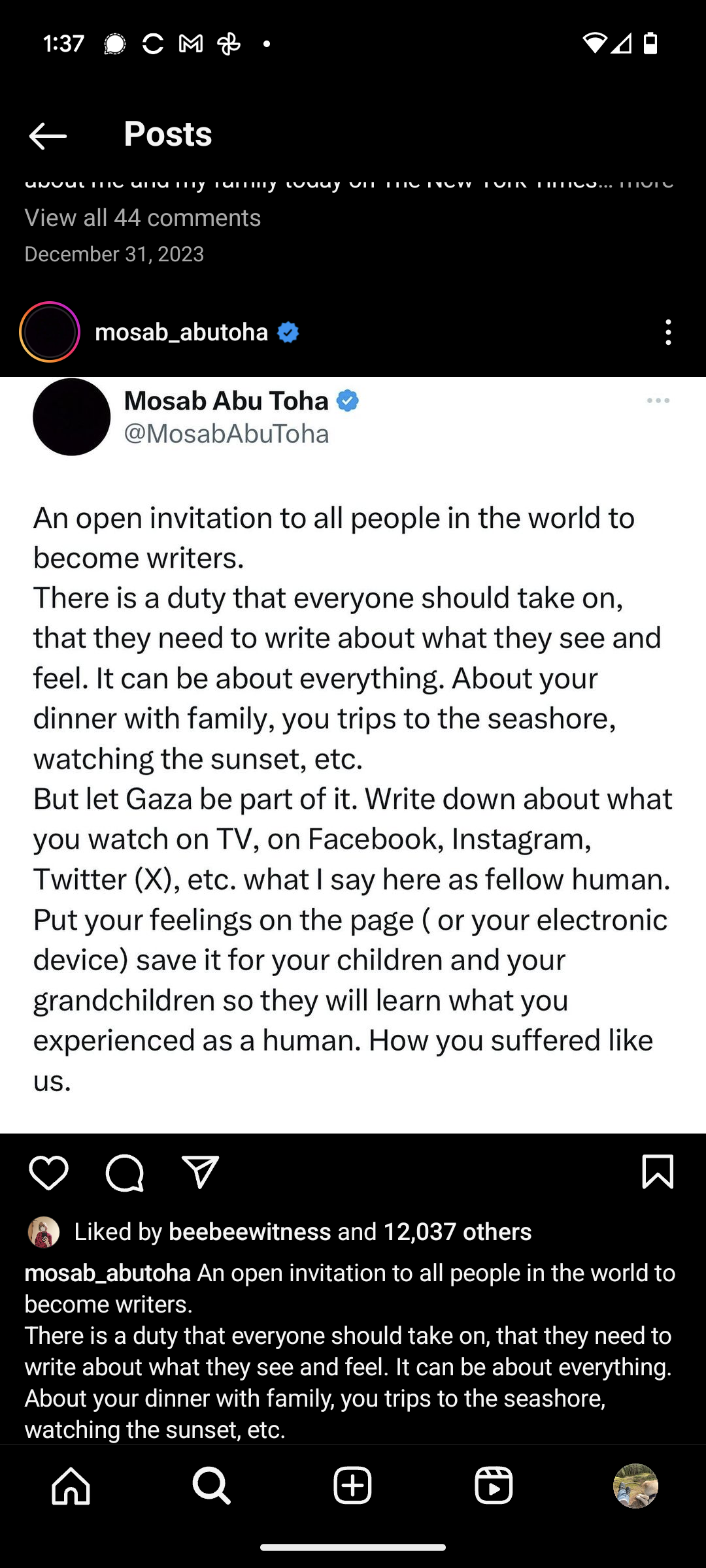
I am used to responding to requests from bipoc people with a solid “yes”, and herein lay a contradiction, a question I couldn’t so easily solve: Why am I so obsessed with Mosab’s charge, and feel so ill-equipped to respond to it? I am feeling so, so much and can’t find the courage to speak, can’t make enough sense out of what is happening, to write. It’s also happening so, so quickly that it’s nearly impossible to keep up with.
My heart has to beat, but does it have to beat like fists, like jackhammers, or is its power also in the pulse of water, propelled tides washing up and down shores, its weight falling on and then re-collecting itself to recede? My throat space is as thin as a layer of ice, as fragile. It is like magnolia petals, it does not bruise easily and it’s wetness holds up during pickling and chopping. Maybe my voice isn’t lacking when it speaks from this place of quiet, of absolute listening. How can we still the world around us so much so that we can speak?
I write this without really being able to open my mouth. What are the words of listening? When are we shattering some thin– very thin– layer between ourselves and what we consider “other”? The quiet is a space of delicacy between ourselves and other, of not wanting to disturb or break anything, to become a little invisible so we can watch something else, or quiet enough to let something else acclimate ourselves to it, and speak from that place. While this might be the reaction to war and genocide, it is not on par with it.
So, how do we move forward? How do we write during critical times?
Listen first– read. When the genocide started, I felt like I didn’t understand Palestine enough, in spite of a lifetime of growing up around people talking about Palestine, of reading and watching documentaries about Palestine, of listening. I pause and put a breath in between myself and this is western stand-in that prizes hierarchical, class-based education over being able to understand and empathize with people, especially those who divisive capitalism has “othered”. How can I know or feel enough to write, to speak?
I also have to consider the news as human, artistic inputs: I’ll be honest, I am reading, sleeping, and eating Palestine and Gaza right now. I lose interest in ig when it’s not about Palestine. Like the psychic charge of a contemporary spell, I am building weight for change by learning, by witnessing. While the IDF and the war machine interrupt the memory and transmission of their crimes, I can help carry the weight of witnessing, so people do not have to do it alone. Palestine is in everything now, in my music, in my food, in the fabric of my day.
Following and supporting journalists, poets and artists is an essential act of solidarity, and something we can do very easily. It’s terrifying to get to this point in the genocide and watch Palestinian voices quiet on my feed, to navigate over to people who have been posting nearly daily to find out if they are dead, if they were able to leave, or if the ever-powerful algorithm has hidden them. I got comfortable getting attached to news reporters, letting myself genuinely care about people I had never met. While we talk about media intake like some sort of diet we have to moderate– too much we get overwhelmed, too little and we are hiding ourselves from the trust. Rarely is it discussed for what it is– as a sacred practice of witnessing. But it’s only the first step. Like some power we grow, a capacity to feel and speak to, to reverberate that widens and expands.
Writing is a spiral, and presence is constant at this time. I know these are broad points, a fuzzy map, that I’ll be following up on weekly. Please email me lycanelvie@gmail.com if you’d like to get on our discord and talk more about this, or leave your thoughts in the comments. No oppressive bs or baiting will be tolerated, TYSM.
*I am an experimental poet, who is also a Marxist, so it’s important for me to pause and do the simple math that is behind sweeping calculus and simple answers– including determining when and how to speak. We have to “show our work”, and truth ourselves. As a mostly white poet with some indigenous background, and a ton of class privilege, I am nearly always defaulting to not taking up space, to making myself small and leaving space for bipoc and working class voices. At least this was true of the east coast Turtle Island communities that raised me; in the PNW, I find myself asked to step up and use my voice more on behalf of people of color. I also admit that, as a non-binary person, and a survivor of a verbal abuse, visibility is confusing (at best). The weight of my voice, and the pieces I use to calculate it, are constantly jumping off the page, moving around, affected by new formulae.
 MoonLit Fern
Hi Fern! I think I found you. We started a new queer witch book club chat on Discord since many of us are no longer using Facebook. It lookes like you left Meta platforms before we could set up the server. My Discord username is beccayant. (note the period) Hopefully you see this comment and reach out to me so that I can add you!
LikeLike