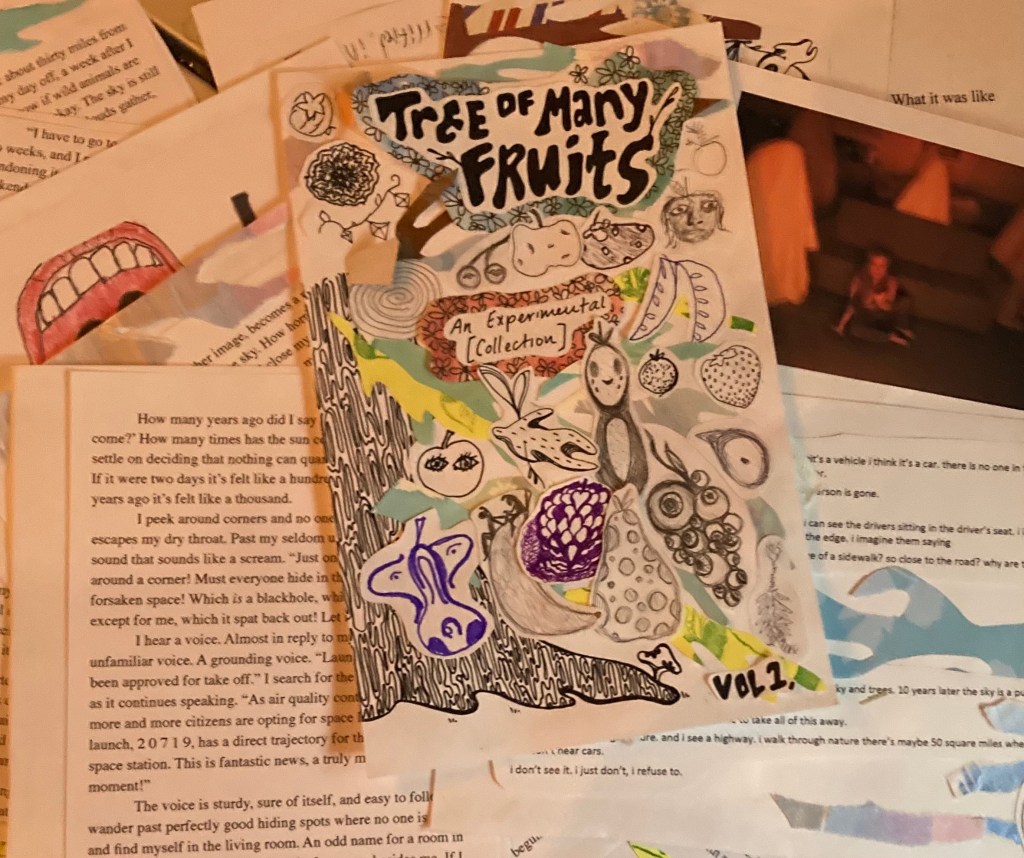
Tree of Many Fruits is anti-copyright, and free for download. If you would like a version that can be printed and assembled into a zine, follow this link to the booklet file. Print double-sided, using short-edge binding (in Layout settings). Fold, staple, and distribute freely.
This was my first attempt at facilitating collaborative, community publishing, and I found it to be a unique art form, one that stands alone, yet can work in-tandem, with individual writing. The poem at the beginning All My Bones are Branches was a collaborative practice: we asked writers to answer the question “What does the forest mean to you?”–aiming for 5 words or less, but open to longer responses. I then re-combined the answers into a poem. I mixed lines to create new meanings, and found myself able to group shared concepts and objects, that appeared across the responses, together into stanzas. This was all without any lateral communication during these exercises, but perhaps shaped by program content.
Art was similarly crowd-sourced: Participants of the class were invited to draw fruits, which we hung from tree branches and trunks cut and tore from collected scrap-booking paper, mostly found and recovered– the most memorable being patterned tissue that once wrapped toilet paper rolls! Together, Kaelin and I assembled the zine: formatting the submissions, laying them out to the split 8.5 X 11″ bounds, taste-testing these fruits, and repeating this process until we found something that resonated. Then, we glued them down, without the need for visual editing software like Canva or In-Design.
Much has been said as to the connections between weaving and words, and we became community “weavers”. While we weren’t sitting in knitting circles or around looms, the “zine team”–a group of students from the program–all contributed thematically in the process and the ethics-building of the publication. Themes of hybridity, along with the zine’s title, came out of the buzzing hive of our initial meetings. Seemingly small choices in small publications spoke deeply of the groups values. Most of the original zine team were drawn into the undertow of the quarter’s work, compounded by social and school obligations. Communicating via email did not reflect the real-time demands of scheduling around weather changes, and the many mishaps of the quarter. By the end, Kaelin and I sat around a metal folding table in their music studio, with the chaos of raw paper materials–the images, the words, the stories and impressions– laying in paper trays I had assembled from office paper that same day, gleaned from a …. creative offshoot, or printing attempt that was destined for the recycling bin. In this world of gods, Sophie and Keiko (Kae’s canine companions) barked and wrestled as we talked about life– the rants and raves–, unpacked the co-creation of science, and asked each other our deeper ecological questions. Like all great friends, we left some holes in our answers, sharing humble ponderances between complications.
The level of respect lent to creators truly broke down any binaries I felt between writer and audience. I pictured the writers reading and viewing their own work within the context of the publication. Choices made to ordering, artwork, and layout were all done with the writer and reader in mind. As I shared a print copy with one of the writers, I saw his eyes light up, and as he shared his reflections, I felt the resonance of seeing work in a publication that had paid attention to the content and tone– and amplified it.
Will I continue this work? Yes, I hope to. Although, as someone processing caretaker and nurturance roles, I struggle to maintain a connection to my “own” voice. Within capitalism, we are often asked to focus on our selves–our own work, our own stories, our own creations, and can think of shifting back and forth between collaborative work and individual is a zero sum game: there are editors, and there are writers. There is “other people’s writing”, and our “own”. Secretly, I found making this collaborative zine to be a new, fun art form; I was challenged to hold and re-fashion the work of the group into something whole and new, a creative process within itself. One of the lessons of this class is that “we” exist as interconnected with a nexus of something larger, of an ecosystem, that our identities and experiences are by no means singular. This was the intoxicating fruit that I found: to widen channels that connect creators across time and space.
After a period of gestation, these new aesthetic powers will show up in my work. In the meantime, I am retreating to much-needed “me time”, and focusing on my own writing. Without that, I am truly lost, and–to channel Miranda–publishing and collaboration definitely can pull focus. While it’s been a labor of love and I am finding belonging in being indistinguishable from a creative whole, I never want to wholly sever the anchor to my own voice. So, for the time being, I’ll be returning to my writing and art-making, and perhaps this, too, falls within what it means to be ecological–to attend to what falls within our immediate circle, and trusting that, in time, we can feel into our branches again.
Cheers, and a massive thank you to everyone in the Fall 2022 Writing as Experimental and Ecological Practice.
I wrote Saguaro when I was living in occupied Hohokam, Yavapai Territory. I was alone–or felt like I was. In reality, I was on the cusp of making deep connections with new people, amidst being ever-reminded of the people who loved me in “other” places. Everything, everywhere, felt so far away, and so close at the time time. In parallel, I was making acquaintance with Saguaro, the great, tree-sized cacti that hold water for months at a time in those deserts. They bear sweet, full-bodied fruits bursting with seeds. Their ability to hold water, to stand, wait and show themselves, and to feed the desert’s kin led me through that time, to knowing I was in community when I felt like I had to hold my breath. It was a long moment as I pushed-pause on experiencing love. I had the van, Elvie and Pabs (of course), and memories and hopes.
Flash forward to March 2020. We are in the first, early months of pandemic. I am suddenly deeply rooted, yet simultaneously cut off–mirroring my time in the desert. I submit Saguaro to Mobile Moon Coop’s Spring Equinox zine (#12), and it is received. With pandemic barring physical readings and gatherings, the publication opted to spread connective language through videos of poets and writers reading their work. With writing, with love, with life, it feels so often that we are flinging ourselves into space, and hoping we are caught, are heard. The silence that follows is often the test of our own security: in ourselves, in our communities, in our past and future selves in over-lap with others. As Mobile Moon–Rikki et al–do such a wonderful job of connecting everyone to foster deep security among these flingings, it felt like this poem belonged especially with Mobile Moon. So, I sat in the snow, gave this paper a flick, and became my letters sent to post-boxes. Below, is that video. Below that, is the poem–Saguaro.
Saguaro
In the desert, I waste time with visions of mountains and snow. My eyes searching for pines, Seeing only Saguaro
Aching for The Water of Someone knowing me hearing my name Spoken From sweet lips
I pass a hillside and a different kind of forest opens up Saguaro Stretching green, thorn-covered leathery skin Great barrel-chested cisterns Standing water above the soil, Holding October’s monsoon water for the later months of now, straws between earth and sky.
Waiting to return it to the earth And the summer’s flowers at their deep rooted feet
The great green bulky arms cleave off to its sides in perfect balance. Clumps of themselves drip like rain drops Waiting to give Gourds of water To the ground For wary travelers- Desert Mice, starved earth
Sitting with Saguaro, I am folded in to this circle of friends and family. The aching over called on from seasons past. A backlog of love letters flood out, Running to the mailbox Pictures of the places I’ve been These circles of Saguaro And not Fir or Spruce poetry so that everyone knows who I love and how.
Water. Someone knowing my name. And me saying theirs: Saguaro
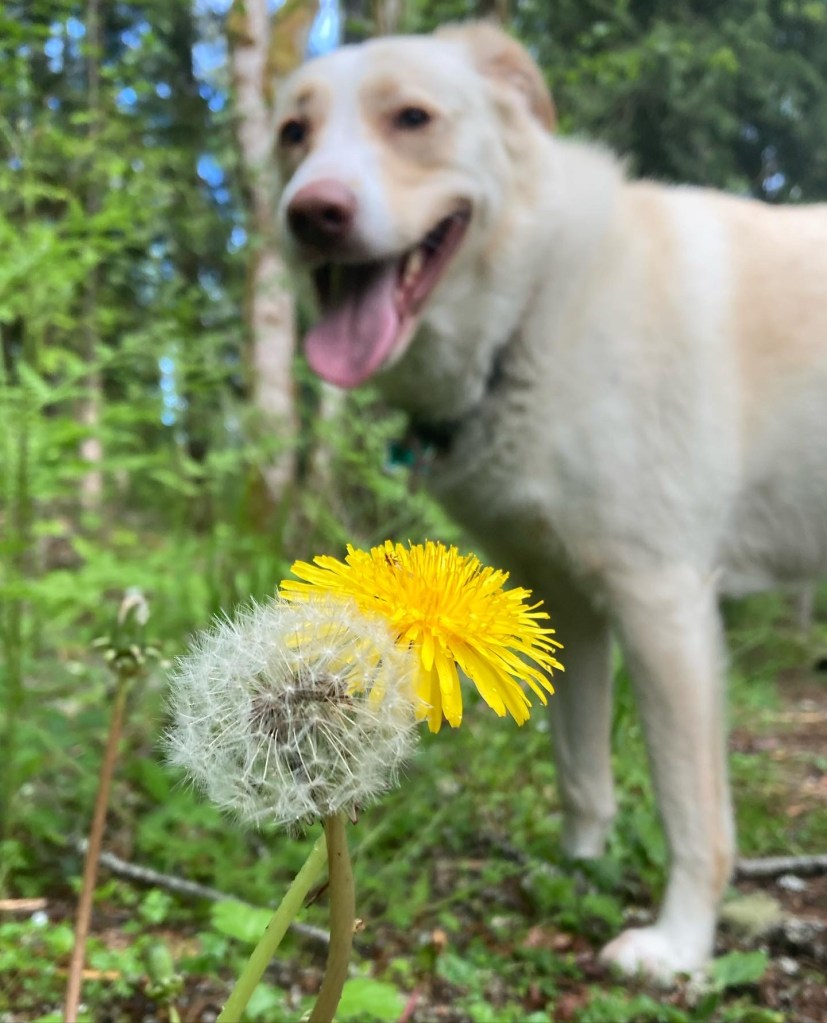
Hi Everyone! It’s with great joy–the deepest joy, which can only come from the dark places–that Elvie-dog and I share with you a new film: Paying Attention. Shot on occupied Twana, Skokomish territory, this was a meditation on how ecosystems and our more-than-human companions hold and support us. Shot entirely on iPhone and edited in iMovie, Paying Attention follows Elvie and myself through life, grief, and back again, through the loss of elder-dog Pablo. Elvie uses her adaptable doggie being to tell all 3 characters’ interwoven stories.
Elvie is truly famous now, and does all her own stunts!
Experimental (aka downright weird) and poignant, Paying Attention recently appeared in the Fireweed Film Festival, and won an award! I loved the support from Marit, Bex, and everyone at Fireweed– a community-led and community-enriching film fest at Graycoast Guildhall. It’s really easy to feel jaded and abraded by publishers, but Fireweed’s gritty acceptance, and wild desire to boost creators made our films rise– as the fireweed stood tall in ditches this July!
“Never done this before? Great!” is my new favorite thing to hear from folks soliciting art!
We also got support from smoocher extraordinaire and super profesh union (IATSE local 488– altho this was not a union show duh) filmmaker Tianse. To do a project with a partner where he never interfered with my process– even when offering feedback–, joyfully followed suit with my requests, answered questions only when I got stuck, and just patiently hung out while I edited for 1.5 days straight, was a true dream (BOYS the bar is SO LOW. You, too, can do this, surely!) Tianse and I have worked on 2 other films together to date, mostly with him taking the lead, so it’s extra wonderful to have a fluid working dynamic with a partner.
Anyhow, grab yourself a Milk Bone, consensually snuggle up with your favorite human or more-than-human kin, and watch here:
Cheers. And if you see a dog helping themselves to a lil romp or a snack, mind your own– it’s a blessing.
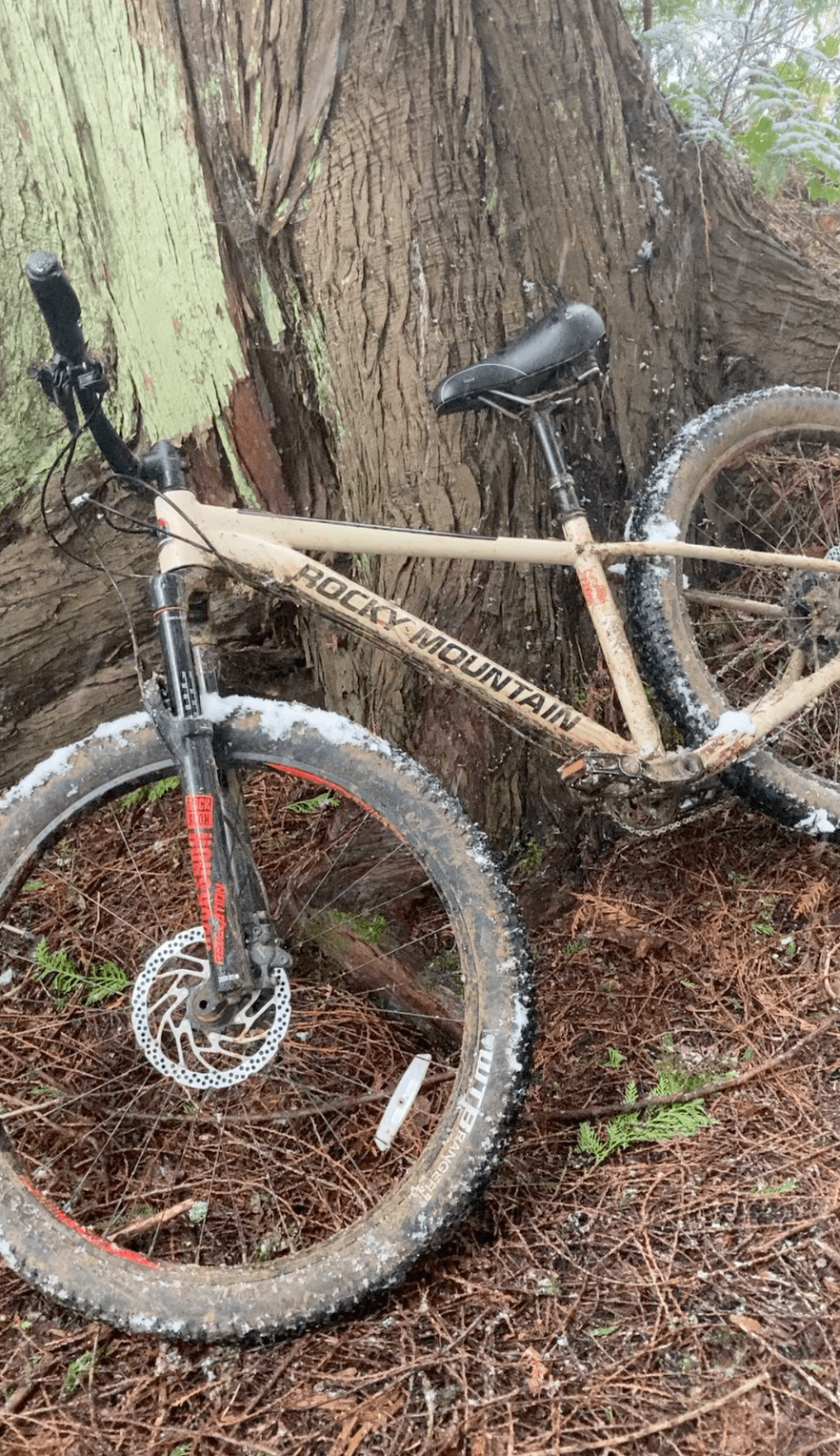
This poem was written deep in Pandemic winter, in response to a simple prompt: to remember a pre-pandemic pleasure: The joy of riding a bike, to a cozy office with a trusted storykeeper.
This piece was in Jackson Hole Poetry Box, February, 2021. As we slowly emerge from pandemic, it’s beautiful to consider the layers of before, during, and emerging in remembering this piece. The physical poetry box, housed at JH Center for the Arts, was at minimal capacity during pandemic, so the curator asked for electronic or video submissions, in addition to a poem that could be printed on real live paper and dropped in the poetry box, waiting openly for passersby to gobbled them up. This request coincided with the first heaviest snowfall of winter, so I concocted this video under these perfect circumstances.
Everything from that time feels like quiet murmurs of the world before and the emerging world. In many ways, I wish we could take some pieces of pandemic life with us into this new landscape: the silence of closed shops and zero social pressures– and all the sensory richness that came with it. But, I’m also stoked to open this box of post-pandemic life.
I share with you spell-wheel: a circular, visual kinesthetic Spellcraft tool, where you can record and channel your connections with this magical world into spells.
All human and more-than-human kin is afoot with magical energy. The world is talking to us all the time, sometimes through silence, too. As we go listening through life, we can pause and record some of the messages, correspondences, and energies we intuit. This tool is in part a space to record your relationship with plants, crafty spell containers, and ecological spheres and threads. It also aids us in aligning these elements. Then, we can draw them in.
Maybe you see a spot in this existence, this time-life-web, that needs a spell: some mending, purge, or even some magnificent magnification. This wheel invites you to sit down, meditate on the issue at hand– and what you want to come into the world. Then, when you’re ready, turn the wheels until these drops of magic align.
Content warnings: suicide, addiction, drug use, institutionalization, police arrest trauma, sexual assault, child abuse and alcoholic caretaker mention
I need rest. Moving rest, sitting down to read rest, feeling rest, playing rest, listening rest. In some ways, I think everything I do is rest from something else I’m doing. I had been on an R.E.M. kick and, on a whim, looked up what films their songs had appeared. One was The End of the Tour, which shows the relationship between David Foster Wallace and an enthusiastic journalist covering his rapid fame, following the release of Infinite Jest. I googled Wallace before I watched the film, as someone had recommended his books to me, but I had not read him. Like a true nerd, I often start with Wikipedia, and my eyes started at the top of the page: simple data, like birth and death dates. I noticed quickly he was just over forty when he died. My stomach sank a little bit immediately, with the knowing of kin. I googled it quickly, and confirmed: David–another writer, another addict, another crazy person like me, had died by suicide.
I think back to my first year of college. Walking around on just one extra hit of LSD, trying to “ground” so I could finish my Logic homework after yet another weekend like this. I think about the cops who had knocked on my friend’s door, with me on the other side, upstairs, naked, in bed, and the cop who threw a bathrobe at me after he was ferried away in a torrent circle of grunting cops. I think about why I would still name that person a “friend” after he had raped me. I think about all the things that brought me to his bedroom: keeping my mom awake as she drove drunk. Me sparingly, but cuttingly, teasing my brother for walking on his toes, but also sticking my hand to keep him out of traffic. Staying up until 12 and waking up at 4 to study for a physics exam. Because 4. and AP classes were going to get me out of there. My dad meeting with us, like an angel who came only for a few hours after school every Wednesday, but if he stayed, closer and longer, became a devil. The sweet older cook who sold us cigarettes in town, who we went to, maybe for the tobacco, but, more likely, because he listened, and he would let us lay down to rest in his wide diner seats.
In the film, Wallace sums up his time on suicide watch in a psychiatric institute: “a pink room with a drain in the center of the floor, which is where they put me for an entire day when they thought that I was going to kill myself. Where I had nothing on, I had someone observing me through a – through a slot in the wall. And when that happens to you, you become tremendously, just unprecedentedly, willing to examine some other alternatives for how to live.”
The movie’s portrayal of David’s experience at a late-seventies psychiatric treatment hospital rang in my ears alongside other stories of older friends from the Haldol era, from photographs of mad folks forced to stand on blocks for hours, with their arms outstretched, about the “safety checks” I knew so well: every two hours someone opening my door, all night, flooding my room with light. And they wondered why I still wasn’t sleeping, and gave me more pills.
These stories make me think about a definition of ancestors: people who have sacrificed so that future generations can thrive and have a better life. Respectability politics would have us believe that passive suffering and victimization is not a contribution, but hearing this story I suddenly knew where I had been, for 2 week periods for forced treatments, in, then out, then in again. For a few cycles of this. Then 4 months. Then out, then in again, then getting sexually assaulted by a doctor on my way in for 16 months. Then out. And staying out long enough to find those “other alternatives for how to live”.
I couldn’t say I was initially desperate to find these “alternatives”. I didn’t believe they existed in the padded walls and plastic plants and the art therapy rooms where I had to be quiet and speak only in turn. They definitely weren’t in the pills that kept me awake and made my skin crawl and felt like there were wads of cotton in the nerves running through my arms. They weren’t in the “healers” all forced to wear nameless, professional clothes, and they weren’t in closed circuit air vents and meals at prescribed times. I can safely say that, as flawed as the system is, our art therapists, psychiatric nurses and techs are often doing their best, and there slipped whispers of healings and their own humanity in through the cracks. And I can say, without a doubt, I did find healings in my conversations with the other interned.
With these things forced on me as “high medicine”, I sort of stopped believing healing exist. But, I am grateful I squirmed and resisted, to keep the hope of these alternatives alive. Once I had given up completely on what was being offered to me, I learned to keep quiet about what was really happening to me, to start lying about my symptoms, so I could get out of these prisons. As scared as I was of being inside my brain and body, maybe I didn’t want to heal, because the system had isolated me, alone, with a paradigm that equated healing with assimilation. Instead of ending suffering. Instead of changing, healing had been brow-beat into me as beingchanged. Becoming normal. Losing myself.
After I was released, I immediately went off my birth control, forced on me because they believed me so sexually uninhibited I would get pregnant while in a locked psychiatric ward. My depression and psychosis improved immediately. My relationship with the psychiatric system was so broken I hid from my prescriber that I had conducted my own taper: removing one medication at a time slowly, spacing out and breaking my pills in half over the course of many weeks, on my own. I even quit smoking cigarettes afterwards. He eventually noticed I hadn’t refilled my prescription, and he said “we could have talked about it, but I guess you don’t need these pills right now”. When I eventually left seeing him, my mother called him up, concerned, but only after we had fought. Just like the years no one noticed I was depressed until my grades would start to slip, and when no one but my friend’s parents knew what was going on at home. We spoke briefly, and he confirmed I didn’t need him. After how many therapists, social workers, and prescribers, I had found an advocate, someone who trusted me.
I don’t think I can truly divorce Disability Justice from the utter failure of our current paradigms, and the deep cruelty of our system, that really killed David Foster Wallace. In disability justice conversations, there is little, if any, inclusion of people with extreme emotional states. While professionals tell us that what is labeled Bipolar Disorder, Borderline, Major Depression, Schizophrenia, Anxiety, and even addictions are all medicalized as “illness”, very few of these make it into conversations around disability justice. All us crazy people are not trying to work, attend school, play outside, write a book, or have families? Today, disability is mostly talked about as chronic illness, ADHD and Autism, and I feel myself so excited for my friends and loved ones who are getting this sort of love, this attention, this inclusion. I know my needs will follow, eventually, in the wake of the room that is made in these conversations. I hope we remember pandemic lessons of inclusion of our homebound community through zoom. I worry that the dry discussions around neurodivergence make it sound so simple, like inclusion could look like us picking a dominant sensory learning type to work with, and ignore trauma. What do we need to add to our discussion of neurodivergence? I feel, often, that more is diverging than my brain; I’m not sure if I can even use that label, when my autistic and adhd buddies seem to wear it so well. I remain mad, on the margins.
In the same way that I have not read Wallace, I have not been to Bloomington, Illinois. However, I can imagine the closing of The End of the Tour: Wallace and the reporter make peace, walking with Wallace’s dog through a light and snow-covered field in the Midwestern university town where Wallace taught. Eventually, I did find these “alternatives for how to live”. I wish Wallace had found them. How can our collective writing practice catch up with a radical view of mental health? How can we trade in this cultural norm of hypercritical writing feedback for something more caring, more accepting? When can we see writing not as an asset or liability, but a reflection of a human being, as Wallace so craves? How can we show we are truly hearing each other?
Things are not easy these days, but they are definitely beautiful, and quieter. My nightmares are better, and I’m starting to talk about certain things unblinkingly, even naming names. I am still here, owing a lot to my white skin, financial privilege and my non-binary body (just barely) passing as cis-femme. I think we can get a little closer to this mythical “there”. The film’s final scene shows Wallace frolicking in the light of an unassuming Baptist church dance group, completely free to express himself, completely at home, without the fears of exposure or being accepted and “cool”, which he so craves and so hates. If we can move from the red pen to allowing every writer to be their own guide, to be loved and truly seen, perhaps David can hear us: Dance on, great ancestor. We will do our best to save each other.
I might not like Infinite Jest. I can tell you right now it is longer than any book I can sit still for. I’m sure I’ll find some scathing detail about Wallace. He, like most famous people, was probably rapey. I am not inclined to put anyone on a pedestal, or obsess about biography. I’m also sure, without a doubt, that I want us all to have some kind of chance to be ourselves.
As the days grow longer, the earth turning its face more and more to the sun, the people around me are bugging and excited with Spring fever. A night owl and winter-lover, the return of the sun can actually be a challenging time for me, my body, mind, and heart struggle to keep up with the buzz. I feel worn out, my brain fried, and also in a whorling, beautiful state.
In spring, nothing is steady. Everything changes day to day, sometimes hour to hour, wind then snow. Is it rain? Is it sleet? Plants bud one hour, then are hit by frost the next. The first forbs are hearty yet tender, the plant life surprising us, surviving this turmoil and fluctuations. Spring shakes off the thick layer of winter silence as snowbanks turn into flooding, slippery mud. The rebirth shakes us on many levels. Snowbanks and icicles that have shaped our world all winter are falling apart.
We mammals wake from the long winter sleep, and some of us are sun-loving, morning people, but not all. The longer days can activate the hypothalamus, reactivating the adrenal glands. All my major manic episodes were in the spring. To complement the “birds and the bees”, the combative energy seems to run through our communities. My friend that works seasonally joked that Spring is “fight or fuck season.” April is the time of Aries, or the warrior Mars, the time of blood and iron.
I live in a place with significantly cold, long winter. In spring, our bodies begin to detoxify the winter grunge. The cold of winter can increase lactic acid buildup, and we tend to drink less water in cold winter. our metabolisms slow, and becoming more efficient. As the metabolism speeds up in the spring, toxins stored in the fat and liver dump into the blood. The longer days, increased stimulation, and junk dumped in our blood creates a lot of stress on our body. The fluctuations in temperature leave me wanting for something to keep me warm.
Enter fire cider. Cleansing, warming, and energizing, it gives me the little extra “bump” to make it through the longer days, easing the transition to waking up. Fire Cider is a spring ritual for me. Mid March, when the snowbanks are hardening and the first inkling of long days start to suggest the spring ramp-up, I hunt for the roots and veggies (mostly in the grocery store, but that carries it’s own type of magic). The anticipation of draining it in a month gets me ready for the transition to spring. Feeling both excited and patient anchors me through all the changes of spring. As the jars of fire cider change from the red of apple cider vinegar, to the yellow-golden color of the infusion, the fresh solar energy of spring grows nearer.
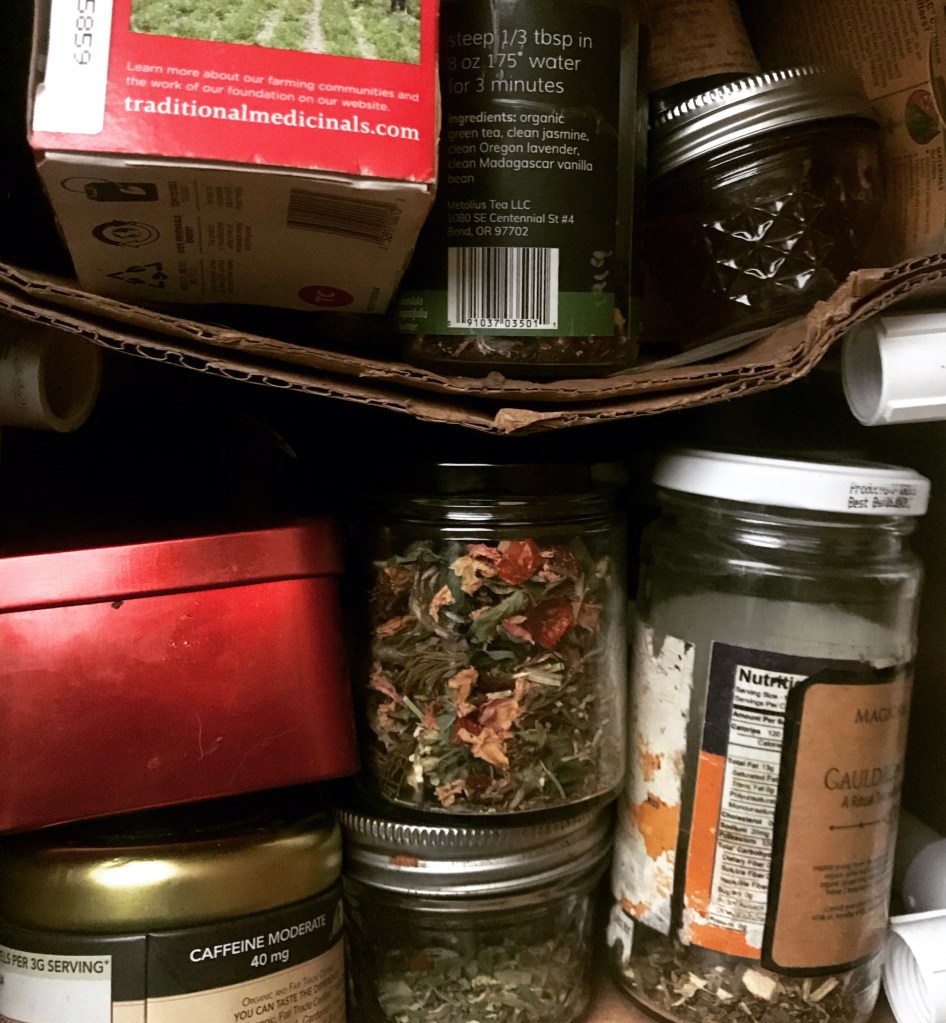
Jar Panic: When you have too many jars with stuff in them
As much as I love spice and hot foods, the stimulation can overload my nervous system. Hot foods like cayenne can be too much for me, jazzing me up. I leave out the cayenne, and include cooling herbs like garden sage, rosemary, and honey.
In addition to the cleansing and energizing effects, the garlic, ginger and horseradish in Fire cider are powerful for kicking spring bugs. The onions and garlic support and stimulate the immune system, and the horseradish flushes congestion like a wasabi shot. For colds and flus, I like to put a few tablespoons in hot water, sit and inhale the steam while I drink, to loosen mucous and move out any invaders. Hot Toddy’s anyone?
So, How Do I Make It?
Combine the following ingredients, put them in a large glass jar, and cover with Apple Cider Vinegar (ACV). Add enough ACV so that there is at least an inch of liquid above the roots, veggies, and spices.
Let sit, covered but able to “breathe”. I like putting a cloth around the top of the jar just to keep things out.
You can chop and grate them by hand, or use a food processor. Chopping all of these hot things will make you sweat and cry. You can wear goggles, running your hands under cold water in between chopping (weird hack that works), or you can take the industrial approach: connect an extension chord to your food processor and run it outside.
Add for a more cooling combo if spring has you over-buzzing:
-4 tbsp dried Rosemary
-4 tbsp dried Garden Sage (Salvia, not Artemisia spp.)
-1/2 Cup Honey
for a more heating combo if you like the heat and spice, add:
-2 Jalapeno peppers
-2 tbsp dried cayenne
For a smokey, woody take, add:
-3 tbsp dried or 1/4 cup grated fresh turmeric
-3 tbsp dried of 1/4 cup fresh Dandelion or Burdock root
I like to label the jar with the date I started the brew. In 2 weeks to a month, drain the infusion. I like to do a multi-step draining process.
What to do with the “marc” (the dry ingredients we strain from alcohol and vinegar infusions)? I like to grind mind and put it in the dehydrator (or a very low heat oven) and combine with equal parts salt to make a spicey salt rub.
Decocted marc fresh from the dehydrator
Ps-A company is selling Fire Cider in stores, which is awesome. What is not awesome is that they tried to trademark the name “Fire Cider.” Some bomb herbalists got together, learned some lawyering, and successful fought it. Yay folk-sters! ❤
Both in the magical and non-magical communities, intergenerational and ancestor healing is resurfacing. The “okay boomer” conversation that happened this Fall ignited feelings of frustration, anger, and reintegration across generational lines. Now we are being hit with a global catastrophe where our elderly are at a higher risk of crossing over, and we are reaching back. What skills do we have, and where did we learn them from? Who came before us? Did we feel loved and accepted by the people who were charged with our survival? Did we listen to each other? What gifts and skills did we receive, and what were we left to figure out from our chosen family? Where did we receive comfort and belonging? What conflicts with our home group surfaced as we come into ourselves?
As conversations about Cultural Appropriation in art, politics, science, knowledge systems, and the spiritual realm grow and evolve, a real need for clarification surfaces. Dispossession-from place, from culture, from the generations that came before- is real. It can leave a hole that people fill in toxic ways, relying on cultures that are not ours to feel connection. If we peer into our own roots, we release the need to take from other cultures.
At the same time, we don’t have to take on everything past generations gave us. How to filter, cleanse, show gratitude, invite, and release different energies and individuals from both our physical lineage and chosen family is messy, beautiful work of rooting, releasing, and belonging. This has been a huge step for me for processing my default experience of rejection, setting boundaries with my family, acting as my true self, and drawing energy from those who have believed in me—both within and beyond my blood family.
My plant for ancestral healing and connection is Elder (Sambuccus nigra and Sambuccus cerulea) . I live in the Northern Rockies, and have always felt an affinity with forests. I am curious which plants hold generational medicine in desert, tropical, and marine environments, but Elder crossed my path many, many times this year, popping up and asking me to work with it. Your plant pal might be different. The practices below are an invitation; if you want to practice them the way I laid out here, and I encourage you to write your own rituals and activities for connecting with the people, cultures, and stories that came before.
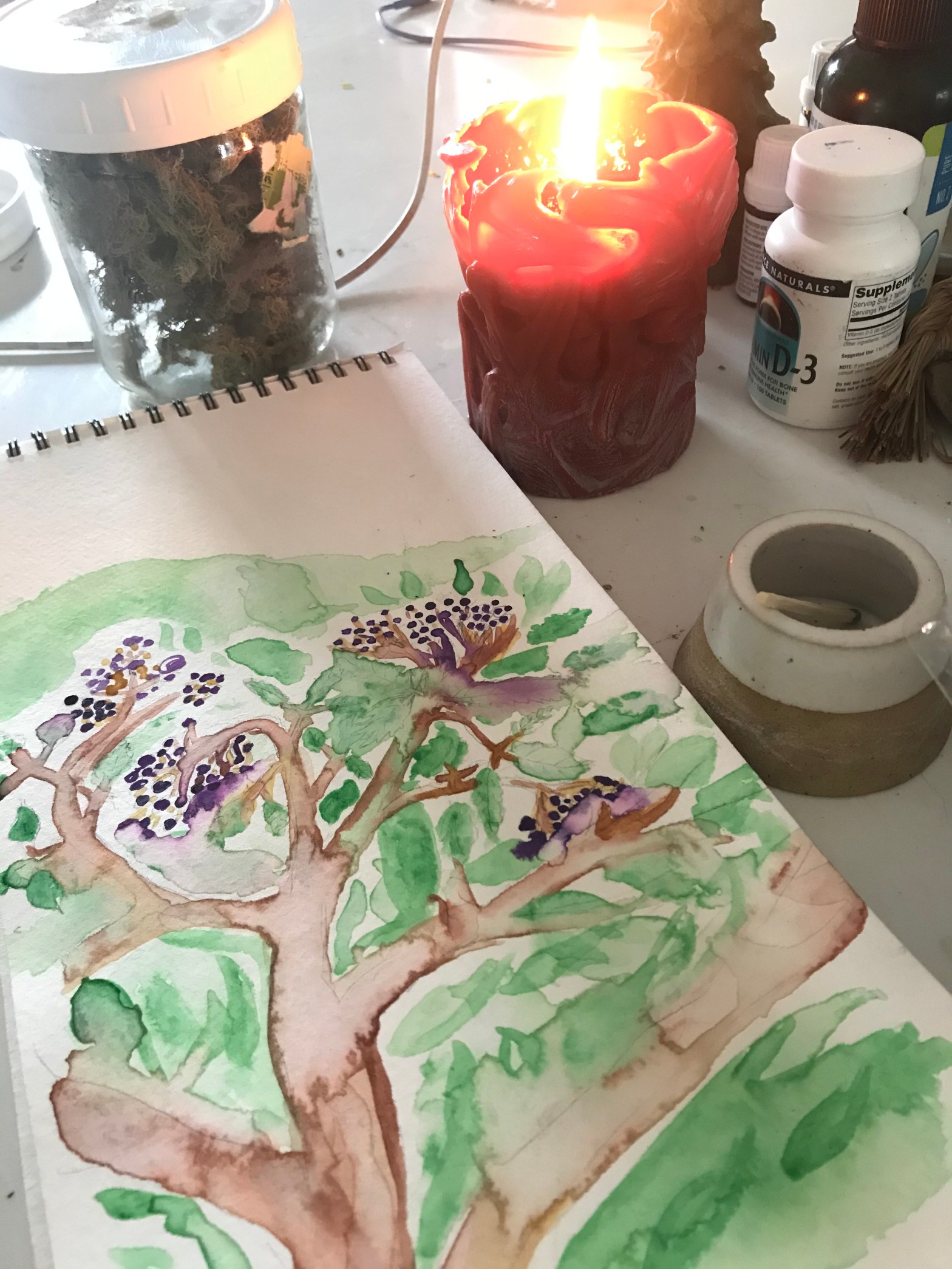
Elder is a powerful ally in this work. A hedge plant, Elder delineates boundaries and loves creekside, much like Hawthorn. It’s a plant of contrasts-serrated leaves that droop softly, long flexible branches with swells of berries. It shows the earth’s terrain, gravitating towards sinking spots and subterranean water pockets. It’s berries, bark, and flowers are wonderful for building immunity. A favorite for spring colds and flus, the branching berry clusters resemble bronchioles. The rich purple berries look like our alveoli. Elderberry is considered an immune tonic and immune builder-safe to take for long periods of time to help build our immune system. While I won’t go deep in to using this plant as medicine, there’s a lot of info out there on Elder!
Amidst the pandemic’s collective whirlwind, Elder has become the center of confusion, and a great teaching tool, around immune herbs. Some plants boost the immune response, while some regulate it. Some do both, like a car with both a pedal and brake system. Elder was always thought to do both—boost, build, and regulate.While people scrambled to learn about plant medicine amidst the pandemic, some people said it could cause the immune over-response that tips Covid-19 cases from manageable to deadly, because it boosts cytokines, which are involved in cell communication and part of a healthy immune response. Too much of a good thing can create a cytokine storm, where cytokines trigger an over-response and immune cells start attacking healthy tissue . But, the herbal communities have not yet actually observed Elder creating a cytokine storm in C-19 patients. The safe suggestion is that it is safe to take Elderberry prophylactically, but to stop using it if you show C-19 symptoms.
Elder is linking us to the ancestors, relying on the knowledge of the past, while also giving us permission to consider the Current moment. It’s talking to us—offering itself as a tool for learning, for inquiry, for communication, turning our gaze to what we trust, and why. Reminding us that the earth might not ever be the same, that the things we once relied on are being brought in to question. The message I received is that it’s okay to question: to search, to consider, and sometimes to return to what has worked.
–Inviting cycles: If you can, find a plant in your area that embodies cycles like this. Spend time with it through the seasons. Brew a cup of elder tea, or the plant ally of your choice. Hold the mug in your hands, inhale the steam deeply, smell and acknowledge the flavors and smells. Let it envelope you. Picture the plant in its ecosystem, going through its cycles-for elder: its feet wet in spring mud, leaves beginning to open, thin branches trailing and the lacy flowers opening, pollinators moving over it, berries sprouting from them, being picked and dropping to the ground, leaves drying, falling to the ground, and the plant’s roots thickening and deepening in fall. Watch as the plant propagates through its root divisions and new seeds, and grows over time, envision the threads of the plants passing through the generations.
Take a moment and feel into this experience of being in cycles. Let the water passing at the feet of elder envelope your feet, taste its fruit. Let death come when it is ready, allowing the cycles to continue. Picture everything repeating, giving way to the next generation, the next generation honoring and holding the last.
If you want a tangible way to get more intimate with the plants, drawing them, either in person or from photo sources, is a wonderful way to gel.
–Generational arrival: Take some time to consider the things you received from generations before the objects, food, values, ideas, and skills. In one column, write out what you want to release, and in another column, write out what you want to receive. In a third, write out what you wish you had received, and allow yourself to receive in from your chosen family. If writing isn’t your thing, feel free just to pause and consider, talk with a friend, or draw out these lists. Mine kind of looked like this:
Receive
Release
Need
-Love of the ocean -Comfort in the mountains -Appreciation of science and knowledge -Appreciation for a home-cooked meal -Knowledge about my geneology, especially marginalized groups in my ancestral line
-Conditional love, and conditional self-love -“Trophy”/accomplishment-driven life -homophobia -transphobia -patriarchal communication -valuing white cultures over Samoan/internalized racism
-appreciation for gender divergence and fluidity -appreciation for divergent sexualities -respect for cultural autonomy -unconditional love and self-love -comfort -calm -bravery -confidence
Take the 3 lists and use them however feels right. I sat on the earth, legs out in front, feet on the ground.
I took the “receive” list and held it at my belly, feeling the fullness, the nurturance, the connectivity sitting inside me like a horizon line, balancing me. I stopped to acknowledge everyone who had contributed to my survival, and felt the arrival of self. The “release” list, I pictured all of those energies flowing out of my body, back into the earth to be neutralized. I paused to allow myself to feel the full gambit of emotions associated with this release: I compassionately acknowledged what my ancestors felt they had to do to survive, mourned them living a life without giving themselves permission to be their full selves, and felt waves of rage awaken me like that hard sweat that expels a spring cold. I let all that pass through me, and back to the earth. I paused and reminded myself of the ground under my feet.
I took the “needs” list-the list of things I needed or had received from people outside my physical family, and held it over my heart. I called in the energies of the caretakers I had throughout my life-camp counselors who let me be brave, strong, and honest; teachers who saw my passions and believed in me; doctors and healers who taught me self-care practices; bosses who believed in me, listened to me, accepted and drove me; artists and activists who were unafraid of being their true, full selves, who paved the way for me to open up. I held this page above my head, where the sun flowed in, and allowed myself to receive fully from a chosen family. I reminded myself that this energy is flowing through my ancestors as well, but is muted or hidden. I paused to acknowledge what they secretly wanted to give me, but couldn’t.
These practices feel differently depending on the day. Sometimes I want to “receive” from the earth at my feet, not push away. Sometimes I want to shield the mental energy coming in from above. There are lots of other ways to work with these lists. You could burn any of them, releasing them and calling in the energy you want through the smoke. You could make a paper airplane and cast it into the wind, or tie this list to a tree and let the winds pass through it. You could bury any of these lists, reminding ourselves of the energy of that which is lost, and gives itself back in return. You could make a little boat and let it surf down a river, away, or make an in-home altar of water, where you let the lists sit in the water, reflecting, soaking up the ink, and then flush them. The possibilities are endless.
–Weaving immunity: Family trees are complicated. Lots of things interrupt our our memories of our lineages: societal institutions like slavery and blood quantum, mental illness, estrangement from a parent, adoption, and other events and factors might cut out an entire body of knowledge about the past, and there is no shame in that. It is okay to accept all of these things, so don’t feel pressure to have a full family tree where you can trace your family back to whatever county… Start by making a family tree of skills, character traits, and memories associated with what you know. Write out the person’s name, where they lived. Then move on to what cultures they were a part of, their passions, a “quirk” or memory you have of them, stories others tell of them. Take a moment to see how these things skip a generation or seem to switch tracks, or are passed on directly.
Pause, and write down their secrets next to their name. The dark things they did to themselves and others. Their struggles. For myself, I have addiction nearly throughout my tree. I sent a breath of radical acceptance, seeing my ancestors fully, not just what I want to see. Above all the branches, write in your chosen family and what they gave you. They are part of your world as well. I would share mine, but it’s honestly too personal. There are lots of family tree options you can find on google images as examples (including ones that acomodate chosen family).
When you are ready, picture strength coming through those branches and down into you. Push away and transform anything that does not serve you or the highest good. Pause and feel what is “budding” from you— the new branches, flowers, and berries emanating from your self. Remind yourself you are safe and deserve to thrive. The ancestors are with you.












 MoonLit Fern